

Carrying Faith in a Digital Age

Alex Ferreira|
Community Author
There is a photograph that circulates occasionally in Catholic online communities. It shows a young woman’s wrist: a smartwatch on one side, a Miraculous Medal bracelet on the other. The image tends to generate comments — some amused, some moved, some defensive. People have opinions about what it means.
I think it means exactly what it looks like: a person living in the present, carrying something old.
Every generation has had to figure out how to hold ancient faith in contemporary hands. The question is not new. What is new is the speed at which the contemporary changes, and the particular pressures it places on interior life.
The digital environment is designed to fragment attention. Notifications, feeds, alerts — the architecture of our devices is built to pull us outward, toward the surface, toward the next thing. This is not a moral failing. It is simply the nature of the medium. But it creates a specific challenge for anyone trying to maintain an interior life: the constant outward pull makes inwardness harder.
This is where physical objects matter more than ever.
The Miraculous Medal is a physical object. It has weight. It has texture. It can be touched. In a world that increasingly exists on screens — flat, frictionless, weightless — the physicality of a medal is not a limitation. It is a feature.
When a person reaches up to touch a medal during a difficult meeting, or feels it against their chest during a moment of anxiety, or holds it in their hand before sleep — these are acts of recollection. They interrupt the outward pull. They create a moment of return to the interior.
This is what the tradition has always called custody of the heart — the practice of returning, again and again, to awareness of God’s presence. The medal does not do this automatically. But it can serve as a prompt, a reminder, a small physical anchor for an intention that is otherwise easy to lose.
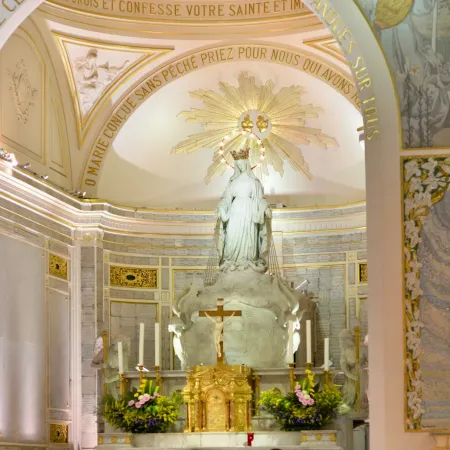
The digital age has also created new ways for the medal’s stories to travel. Communities of devotees exist on every major platform. People share accounts of graces received, ask for prayers, distribute medals to strangers they have met online and will never meet in person. The Rue du Bac chapel has a website. You can watch a livestream of Mass from the chapel where Catherine Labouré received her visions.
This would have been unimaginable in 1830. It would also, I think, have seemed entirely consistent with the spirit of the medal’s origin — which was always about reaching as many people as possible, through whatever means were available.
The means change. The reach is the point.
What does not change is the interior dimension. The medal can be shared digitally, but it cannot be worn digitally. It has to be held, put on, carried. The grace it mediates — if we believe it mediates grace — is not transmitted through a screen.
This is a useful reminder. The digital world is real, and it matters, and it can serve devotion. But it cannot replace the embodied, physical, particular life in which faith is actually lived.
The young woman with the smartwatch and the medal bracelet understands this, I think, even if she has never articulated it. She is not confused about which world she lives in. She lives in both. She is carrying something old into something new, which is what every generation of believers has always done.
It is, in its way, a form of faithfulness.