In Silence, the Medal Speaks
Anonymous|
My son died in 2016. He was thirty-one years old. The cause was an accident — sudden, without warning, without the preparation that illness sometimes allows. One day he was here. The next day he was not.
I will not write about the grief itself. Anyone who has lost a child knows that it cannot be written about adequately, and anyone who has not cannot fully understand what is written. I will only say that it changed the architecture of my interior life in ways I am still discovering.
Before my son died, I prayed with words. I said the rosary. I said the prayers I had learned as a child, the ones I had taught my children. I spoke to God and to Mary in sentences, with requests and gratitude and the ordinary conversation of a faith that had been part of my life for sixty years.
After he died, the words stopped.
Not the faith — the faith did not stop, though it changed shape in ways I could not have predicted. But the words stopped. I would sit in the church near my house, or kneel beside my bed, and open my mouth to pray, and nothing came. The sentences I had used all my life felt inadequate in a way they never had before. They were too small for what I was carrying.
What remained was the medal.
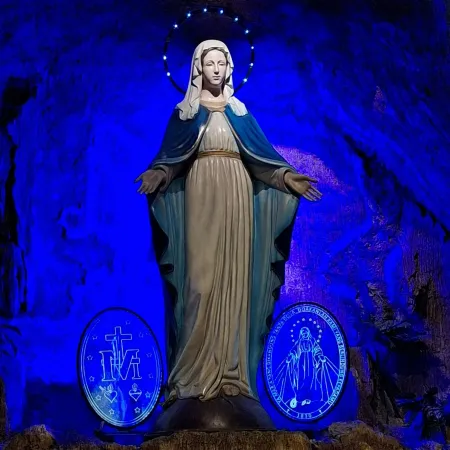
I had worn a Miraculous Medal since my own confirmation. I wore it through my marriage, through the births of my children, through the ordinary decades of a life. After my son died, I found that I could not pray in words, but I could hold the medal. I could press it between my palms. I could feel its weight and its edges and the slight relief of the image on its surface.
This became my prayer. Not words. Just the holding.
I do not know how to explain what happened in those moments of holding. I know that something was communicated — not by me, because I had nothing to say, but to me. A sense of presence. A sense that the silence was not empty. A sense that what I was carrying was being carried with me, by something larger than I could name.
A priest I spoke to in those years said something that has stayed with me. He said: Sometimes the deepest prayer is the one that has no words. The holding itself is the prayer. Mary understands what you cannot say.
I think he was right. I think the medal, in those years, was doing something that words could not do — holding the space between my grief and whatever lay beyond it, keeping a connection open when I had no language for the connection.
My son had worn a Miraculous Medal. I did not know this until after he died — his wife told me. She said he had worn it since university, that he had never spoken much about it, that it was simply part of how he dressed.
I wear his medal now, alongside my own. Two medals on the same chain.
I still do not pray much in words. But I hold the medals every morning, and every night, and in the difficult moments of the day. And I believe — not with certainty, but with the kind of trust that is all that remains when certainty is no longer available — that he is held too. That we are both held. That the silence between us is not empty.
This is what the medal carries, for me. Not a formula. Not a guarantee. Just the weight of a small thing that says: You are not alone in this. Not in any of it.