Something to Leave Behind
Anonymous|
Carpenter, Bordeaux
My father was not a religious man. He had been raised Catholic, the way most people of his generation in this part of France were raised Catholic — baptized, confirmed, married in the church, and then largely absent from it for the following forty years. He did not speak about faith. He did not speak against it either. It was simply not part of his daily life.
When he was dying — he had cancer, and the last weeks were in a hospice outside the city — I did not know what to bring him. I am not much of a talker. Neither was he. We had spent most of our lives together in a comfortable silence, working with our hands, not saying much.
My wife suggested the medal. She had worn one for years, and she pressed one into my hand the morning I drove to the hospice. She said: Take this. You’ll know if it’s the right moment.
I put it in my jacket pocket and forgot about it for most of the visit. We sat together. I held his hand. He slept more than he was awake. There was not much to say, and we did not say it.
Near the end of the afternoon, he opened his eyes and looked at me for a long time. He seemed very clear — clearer than he had been in days. He said: I don’t know what happens next.
I said: I don’t either.
He nodded. He seemed to find this acceptable.
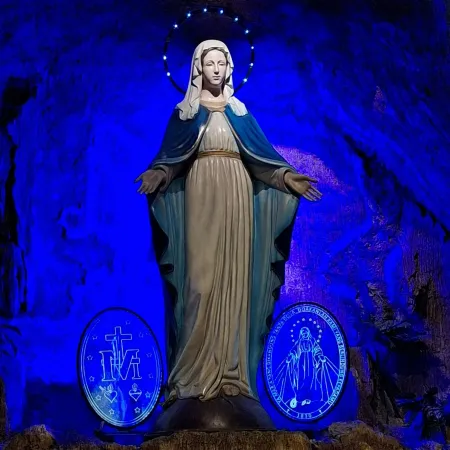
I reached into my pocket and took out the medal. I put it in his hand and closed his fingers around it. I did not explain it. I did not say anything about Mary or intercession or the history of the object. I just put it in his hand.
He looked at it. He said: I remember these.
I said: You can keep it.
He died two days later. He was holding the medal.
I did not see it happen — I had gone home to sleep, and he died in the early morning. The nurse called me. When I arrived, his hand was still closed around it.
I left it with him.
I have thought about that moment many times since. I am not sure what I believe about what happens after death. I am not sure my father was sure either, in those last days. But I know that something passed between us when I put that medal in his hand — something that did not need words, that could not have been said in words.
It was not a promise. It was not a guarantee of anything. It was more like a gesture that said: You are not going into this alone. Other people have held this. Other people have been afraid and have held this. You are part of something that has been going on for a long time.
My wife gave me another medal after the funeral. I carry it now, in the same jacket pocket. I am not sure I would call myself a religious man, any more than my father would have. But I carry it.
Some things do not need to be explained. They just need to be passed on.